
Some leaders seem to have an extraordinary ability to land on their feet.
Plans fall through, circumstances change, deadlines approach, and somehow, things work out. Opportunities appear at just the right moment. Someone steps in to fill a gap. A potential crisis resolves itself. And the organization moves forward.
It's tempting to admire this kind of leadership. There is something appealing about a person who can navigate uncertainty with confidence, make decisions quickly, and embrace opportunities others might hesitate to pursue.
But I've often wondered: When things repeatedly work out, how do we know whether we're witnessing effective leadership or simply good fortune?
And perhaps more importantly, does the distinction matter if the organization continues to succeed?
Two Schools of Thought
There are two approaches to leadership that I find particularly interesting.
The first emphasizes intentionality.
Leaders establish direction, anticipate challenges, build systems, evaluate risks, and prepare their organizations for what lies ahead. The underlying belief is that thoughtful planning creates stability, consistency, and the capacity for sustainable growth.
The second emphasizes adaptability and opportunity.
Leaders remain open to possibilities, make decisions with incomplete information, and recognize that some of the most meaningful opportunities cannot be anticipated. They understand that waiting for perfect conditions can mean missing an opportunity altogether.
Both approaches have merit. Both also have limitations.
Excessive planning can produce rigidity, slow decisions, and discourage experimentation. Conversely, an overreliance on spontaneity can create confusion, unnecessary risk, and inconsistent execution.
So which approach is more effective?
Maybe we're asking the wrong question.
When Opportunity Knocks
In his book Eat Mor Chikin: Inspire More People, Chick-fil-A founder Truett Cathy offered a philosophy that has stayed with me:
"Take advantage of unexpected opportunities."
What I appreciate about this philosophy is that it recognizes something no strategic plan can fully account for: the unexpected.
Yet there is an important distinction between being open to opportunity and depending on opportunity.
Cathy's approach also includes things like financial breathing room, meaningful relationships, and an awareness of what's happening beyond our immediate responsibilities. These things can position leaders to recognize and pursue possibilities they never anticipated.
A leader must be able to work with their head down, attending to the responsibilities of today, while also keeping their head up, watching for the possibilities of tomorrow.
Perhaps planning and spontaneity aren't competing strategies. Perhaps intentional preparation is precisely what enables us to take advantage of unexpected opportunities.
When Taking the Chance Pays Off, and When It Doesn't
I've experienced this tension firsthand.
In a previous executive leadership role, our organization was presented with an unexpected opportunity to establish an internship partnership. The opportunity was promising, but the timeline was extremely compressed. We had very little time to design the program, identify meaningful projects, prepare the receiving departments, and establish the operational support necessary for success.
We elected to move forward.
I developed a plan quickly, and in the end the initiative produced some genuinely positive results. We established a new partnership, created an internship opportunity, and made meaningful progress on work that might otherwise have remained unfinished.
Had we insisted on a more conventional planning timeline, we might have missed the opportunity entirely.
But the experience also revealed the cost of moving before we were adequately prepared.
Onboarding difficulties, delayed access to critical software programs, and a multi-day unexpected leadership absence complicated the experience for one participant, who elected to leave both the internship and the placement agency.
There were undoubtedly factors beyond our organization's knowledge or control. I cannot say with certainty that additional preparation would have changed the outcome.
But I do know that the consequences extended beyond our organization.
We lost the participant's potential contributions and the progress anticipated on an important operational project. Our partner lost the opportunity for a successful internship completion and potential placement. And the participant lost an opportunity for professional experience and a possible pathway into employment.
That's a significant amount of unrealized potential.
Was accepting the partnership opportunity the wrong decision? Not necessarily.
Did we accomplish worthwhile things? Absolutely.
But the decision to pursue an opportunity and the decision about how to execute it are two separate leadership responsibilities.
And I believe we have an obligation to evaluate both.
Leadership Is Also About the Wake
One of my strongest convictions is that leadership cannot be evaluated by project outcomes alone.
It's also about the wake. The people affected along the way. The trust strengthened or strained. The resources preserved or exhausted. The relationships built or damaged. And the opportunities created or lost because of the decisions we make.
Getting across the finish line matters. But so does getting there with the team intact, the organization's reputation intact, and the resources, relationships, and operational health necessary to pursue whatever comes next.
Consider two organizations that achieve the same objective.
One gets there through thoughtful preparation, clear expectations, effective communication, and the flexibility to adapt when circumstances change.
The other gets there through repeated last-minute adjustments, unclear responsibilities, extraordinary employee effort, and circumstances that somehow continue to work in its favor.
The outcome may be identical.
But are both organizations equally healthy? Equally prepared for the next challenge? Equally capable of sustaining or expanding their success?
I would argue that they aren't necessarily.
Leaders have every right to accept calculated risks. But our personal comfort with uncertainty does not mean our teams, clients, or partners have the same capacity or willingness to absorb the consequences.
And those consequences aren't always captured in a performance report.
To evaluate leadership well, I believe we should consider three things:
The outcome: What did we accomplish?
The wake: What did it cost the people, relationships, and resources involved?
The unrealized potential: What opportunities or future benefits may have been lost along the way?
Success deserves celebration. It also deserves examination.
You Can't Scale Good Fortune
As organizations grow, complexity increases.
I think of it like juggling. Juggling two balls is relatively straightforward. Add a third, fourth, or fifth, and the challenge changes considerably.
The methods that work when an organization is small may not remain effective as its responsibilities, workforce, customers, and commitments expand.
That's where intentional systems, leadership development, clear processes, and organizational planning become essential.
———————> But there's a paradox here.
The same dependence on familiar processes that creates stability can eventually create rigidity. And an organization that becomes too comfortable with what has always worked may fail to recognize when something needs to change.
Success today does not guarantee success tomorrow.
Which brings me back to our two schools of thought.
I don't believe leaders must choose between planning and opportunity. I believe the more useful distinction involves two independent characteristics:
how intentionally we plan
and
how open we remain to unexpected possibilities.
An Exploratory Model of Leadership
A leader can be highly intentional and highly adaptable. Likewise, a leader can operate with little preparation while remaining exceptionally receptive to emerging opportunities.
But being open to an opportunity doesn't automatically mean we're prepared to execute it well.
And having an excellent plan doesn't guarantee we'll recognize when it's time to change course.
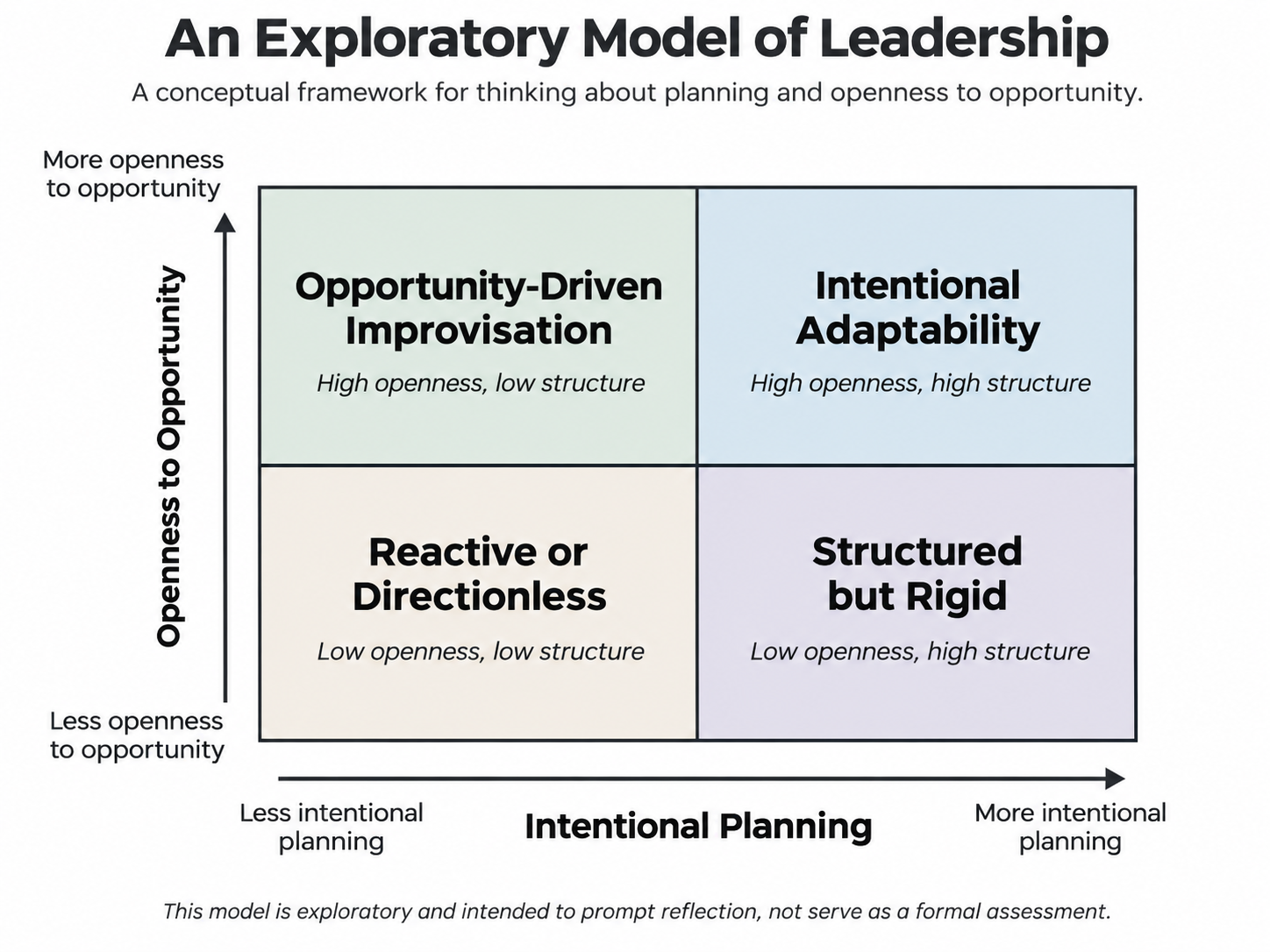
This isn't a scientific assessment or a ranking of leadership styles. It's a way to examine the relationship between two characteristics that are often treated as opposites.
When Success Teaches the Wrong Lesson
Perhaps one of the greatest risks of repeatedly favorable outcomes is the confidence they can create.
When things work out, it's easy to assume our approach was sound. But a favorable outcome doesn't necessarily validate the decisions that preceded it.
We can make an excellent decision and experience a disappointing outcome. We can also make a poorly considered decision and experience remarkable success.
Without reflection, we risk confusing the two.
And when an organization repeatedly succeeds despite preventable gaps in planning or execution, those gaps can remain unaddressed until the consequences become too significant to ignore.
That's why I believe leaders must be willing to ask not only whether something worked, but why it worked, what it cost, and whether the approach remains appropriate for the future.
Perhaps luck and intentionality aren't actually opposites. Perhaps the real distinction is between leaders who respond to unexpected opportunities and leaders who depend on them.
I believe the strongest organizations preserve the curiosity, flexibility, and entrepreneurial spirit that open doors to unexpected possibilities while intentionally building the stability and capacity to walk through those doors successfully.
After all, the goal isn't to eliminate uncertainty. It's to develop an organization capable of navigating uncertainty without sacrificing its health or reputation.
I'd Love to Hear Your Perspective
Think about a defining moment in your leadership experience.
Was it the result of careful planning, an unexpected opportunity, or some combination of the two?
And looking back, would more planning have improved the outcome, or might it have prevented the opportunity altogether?
I'd love to hear how other leaders have navigated that tension, and what their experiences have taught them about the relationship between intentionality, adaptability, and success.